How Much Does an Acre of Land Cost?
The "Average" Price and 7 Factors That Define Value
If you have ever dreamed of building a custom home, starting a homestead, or investing in real estate, you have likely asked the ultimate question: "How much does an acre of land actually cost?"
It seems like a simple question, but in the United States real estate market, the answer is anything but simple.
Asking for the "average" price of an acre is a bit like asking for the "average" price of a car. Are we talking about a used sedan with 200,000 miles, or a brand-new luxury sports car? The price difference is astronomical.
While national averages exist, they are often misleading. An acre of barren desert in Nevada might cost $500, while an acre of prime residential land near downtown Seattle could cost $5 million.
This guide will look at the current national data and, more importantly, break down the seven critical factors that determine why one acre is vastly more expensive than another.
The "Average" Number (And Why You Should Ignore It)
Before we dive into the factors, let’s address the number everyone wants to know.
According to recent data from sources like the USDA and various land listing marketplaces, the average cost of farm real estate (including land and structures) in the U.S. hovers around $3,800 to $4,500 per acre.
However, this number is heavily skewed.
This average includes millions of acres of massive, rural farmland and ranchland in the Midwest and Plains states. If you are looking for a 1-acre lot to build a house near a city, that "average" is completely irrelevant to you.
For residential-zoned land near populated areas, you should expect prices ranging anywhere from $20,000 to well over $200,000 per acre, depending entirely on the factors listed below.
The 7 Factors That Actually Determine Land Price
When evaluating land, you have to look beyond the price tag and understand what you are buying. Two identical-sized square acres can have values that differ by 10,000% based on these variables.
1. Location, Location, Location
This is the golden rule of real estate for a reason. Proximity is the single biggest driver of cost.
Urban vs. Rural: Land within commuting distance of a major metropolitan job market will always command a premium. An acre 30 minutes outside of Atlanta is exponentially more valuable than an acre three hours away.
State by State: Averages vary wildly by geography. An acre in New Jersey or California (where land is scarce and population is high) will cost significantly more than an acre in Wyoming or New Mexico.
Neighborhood Dynamic: Even within the same county, an acre next to luxury custom homes will cost more than an acre next to an industrial park.
2. Access to Utilities ("Raw" vs. "Improved" Land)
This is where many first-time land buyers get sticker shock. There is a massive difference between "raw land" and "improved land."
Raw Land: This is untouched wilderness. There is no electricity, no municipal water, no sewer system, and no internet cable nearby. While the purchase price is low, the cost to run utilities to the site can be tens of thousands of dollars.
Improved Land (Builder Ready): This land already has utility stub-outs at the property line. You can essentially pull a permit and start building. You pay a premium for this convenience, but you save on development headaches.
3. Topography and Usability
Just because you own an acre doesn't mean you can use the whole acre. The physical characteristics of the land dictate its value.
Flat and Clear: The ideal building lot is relatively flat, not heavily wooded, and has stable soil. This is the most expensive type of topography.
Challenging Terrain: Land that is steeply sloped, extremely rocky, or heavily forested is cheaper because it costs much more to prepare a building site.
Water Features and Hazards: While a stream might add value for aesthetics, land located in a FEMA 100-year flood zone or containing designated wetlands can be drastically cheaper. Why? Because building on it may be difficult, expensive, or outright illegal.
4. City Limits and Zoning
Regulatory factors play a huge role in value.
Inside City Limits: Land inside a municipality generally costs more. You get access to city services (police, fire, water, sewer, trash), but you also pay higher city taxes and are subject to stricter building codes.
Zoning Laws: What are you legally allowed to do with the land? A parcel zoned "Commercial" is usually more valuable than one zoned "Residential," which is more valuable than "Agricultural." If you buy agricultural land hoping to build a subdivision, you might find yourself unable to do so.
5. Road Access
How do you get to the property?
Paved Road Frontage: Land that borders a maintained public road is the standard and commands full price.
Dirt/Gravel Road: Access via a county-maintained dirt road may slightly lower the value compared to pavement.
Landlocked or Easement Access: If the only way to get to your land is by crossing someone else’s private property via an "easement," the value of the land drops significantly. It can make financing difficult and cause neighbor disputes.
6. HOA’s and Covenants
Homeowners Associations (HOAs) and deed restrictions are a double-edged sword for land value.
The Pros: An HOA ensures that your neighbors can't turn their property into a junkyard, which protects property values. Land in a nice HOA community is often more expensive.
The Cons: HOAs come with monthly or yearly fees and restrictive rules on what you can build, what color you can paint, and even what pets you can have. For buyers seeking freedom, an HOA is a negative factor.
7. Perk Tests and Soil Quality (For Septic)
If the land does not have access to municipal sewer, you will need a septic system. Before you buy, the land needs a "Perc Test" (Percolation Test).
This tests how quickly the soil absorbs water. If the soil has too much clay or high bedrock and fails the perc test, you may not be able to install a standard septic system. This can render a residential lot almost worthless, or require incredibly expensive alternative septic systems.
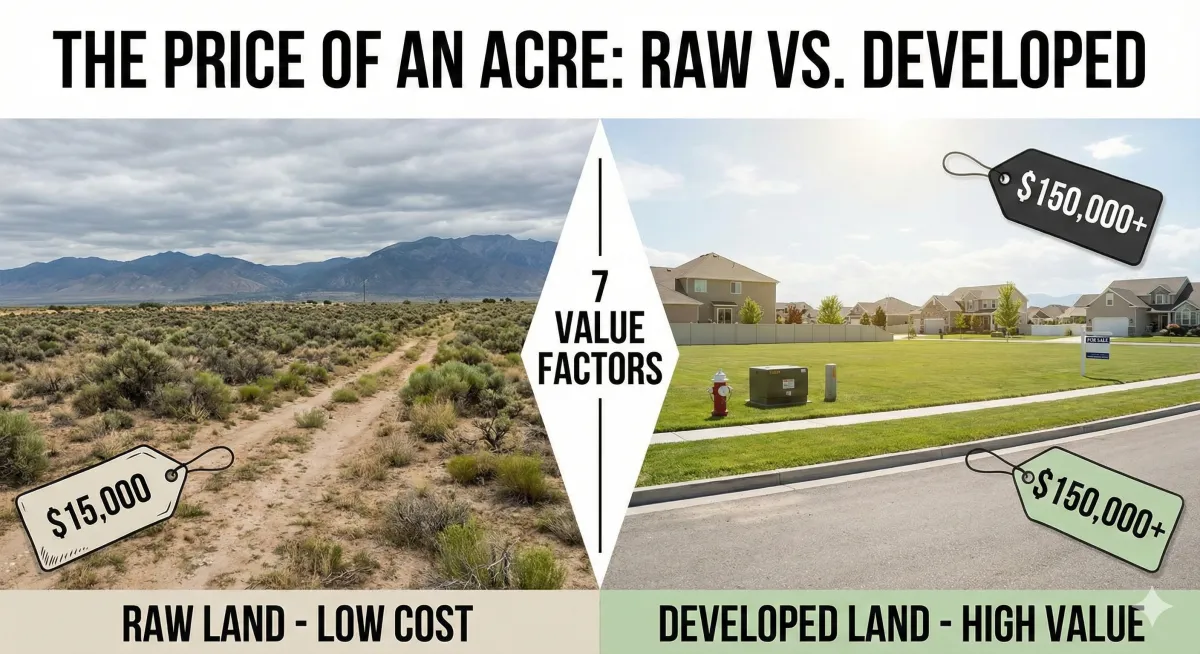
The Tale of Two Acres: A Comparison
To visualize this, imagine two different one-acre lots in the same state:
Acre A: The $15,000 Lot
Location: Rural, 90 minutes from the nearest city.
Utilities: None available nearby.
Topography: steep slope, heavily wooded.
Access: Dirt easement road.
Zoning: Agricultural/Rural Residential.
Acre B: The $150,000 Lot
Location: Suburban, 20 minutes from downtown.
Utilities: Electric, water, and sewer at the street.
Topography: Flat, cleared grassy field.
Access: Paved county road frontage.
Zoning: Residential, inside city limits with no HOA.
Both are exactly 43,560 square feet. But Acre B is "shovel ready," while Acre A requires massive investment before it is usable.
Conclusion: Do Your Due Diligence
When asking "how much does an acre cost," remember that the initial price tag is just the beginning of the story. Cheap land is rarely cheap once you factor in the cost of making it usable.
Before buying land, always work with a real estate agent specializing in land sales, and ensure your contract has a "due diligence period" so you can investigate utilities, zoning, and soil quality before committing your cash.