
Seller Financing Land: How to Write an Offer Sellers Will Accept
How to Write Seller Financing Offers to Buy Land
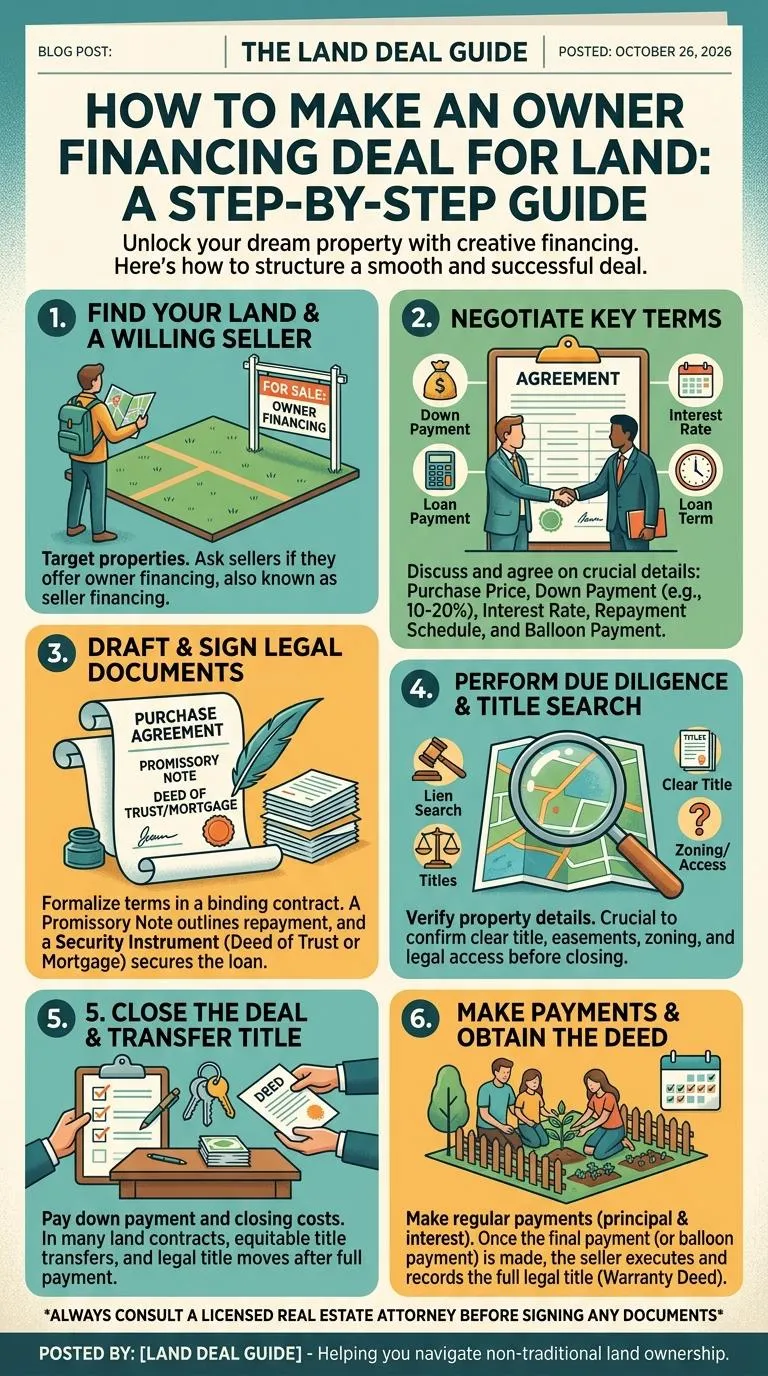
If you're buying land and don't want to deal with a bank, seller financing (also called owner financing) is one of the best tools you have. The landowner basically becomes the bank. You pay them directly over time, usually a down payment up front and monthly payments after that. When it's structured well, it works for both sides: you get financing without bank underwriting, and the seller gets steady income (often with interest) instead of one lump sum check.
Here's how to actually put together an offer that gets a yes.
Start With the Seller's Motivation
Seller financing works best on sellers who don't need all their cash right now. Think retirees who want steady monthly income, investors trying to avoid a huge capital gains hit in one tax year, or people who inherited land free and clear with no urgency to sell it fast. Before you write anything, figure out what's actually motivating this seller and speak to that. Some people care most about the interest rate. Others just want to avoid realtor fees and the hassle of listing.
Where to Find Sellers Open to This
You won't find "seller financing available" plastered on most listings, but some places have a much higher concentration of sellers who'd say yes if you asked. Facebook Marketplace, Craigslist, and even eBay land listings tend to skew toward private sellers who listed the land themselves instead of going through an agent. Those are the people most open to a creative deal, since they're already comfortable dealing directly with a buyer instead of going through a traditional sale.
Don't rule out agent-listed land either. If a property is listed with a realtor, call the agent and ask if their client would consider owner financing, as long as the realtor still gets their commission out of the down payment or an early payment. Plenty of agents will bring the idea to their client if you make it clear their commission isn't at risk. It's an easy ask, and it opens up deals you'd otherwise skip just because they're listed.
Lead With the Key Terms
Don't bury the numbers in legal language. A clear offer should spell out:
Purchase price
Down payment amount (commonly 10 to 20 percent, though land deals can go lower)
Interest rate you're offering
Loan term or amortization schedule (5, 10, 15 years, sometimes with a balloon payment)
Monthly payment amount
How title gets handled during the payment period: a land contract/contract for deed, or a deed transferred to you up front with a mortgage or deed of trust back to the seller
Put these in a simple one-page summary before you send any formal contract. Most sellers have never done owner financing before, so the easier you make it to understand, the faster they'll decide.
Make the Numbers Easy to Say Yes To
Most sellers aren't thinking in loan terms. They want to know how much they get and when. Show them the monthly payment, the total interest they'll earn over the life of the loan, and the down payment you're putting up as good faith money. Simple and clear beats detailed and confusing every time.
Include the Legal Safety Nets
Even a friendly, casual-sounding offer needs a real promissory note attached, plus a deed of trust, mortgage, or land contract depending on your state, and clear terms for late payments and default. This protects both of you and tells the seller you're serious, not just improvising a handshake deal.
Address the Seller's Risk Concerns Directly
Sellers thinking about financing a deal themselves usually worry about two things: not getting paid, and the buyer letting property taxes lapse. Get ahead of both. Keep the seller as lienholder until the loan is paid off, agree to pay taxes directly, or offer a bigger down payment to show you're committed.
Close With a Clear Next Step
End the offer with an actual call to action. Give a deadline to respond and offer a call to answer questions. An offer that just trails off with no next step is how you lose momentum with a seller.
A Few Practical Things to Know Before You Send an Offer
A few things worth knowing before you start writing offers.
Price matters. Seller financing tends to make sense on properties priced above roughly $20,000. Below that, the fixed cost of title work and drafting a note usually isn't worth it for either side, and the numbers get tight fast.
Call a title company before you finalize your terms. Not every title company handles owner-financed closings. Some only work with cash or traditional mortgage deals. Even the ones that do the closing won't always service the note afterward, meaning collecting payments, tracking the payoff balance, and issuing the deed once it's paid off. Call ahead and confirm they can actually handle the structure you're proposing before you write it into an offer.
Don't try to close the deal yourself. It might be tempting to save money and handle the paperwork between you and the seller directly, but that's how buyers end up with a property that has liens on it, an unclear title, or a deed that never actually gets recorded. A title company does a title search to catch any of that before you send money, and then records the deed (or your interest in the property) with the county. Being in the public record is what actually protects you as the buyer. Without it, you have no real proof of your claim to the property if the seller tries to sell it again, if a lienholder comes after it, or if there's ever a dispute down the road.
Your state matters, a lot. State law shapes what kind of contract even makes sense to use. Some states are judicial foreclosure states, where a lender has to go through the court system to foreclose, and some are non-judicial, where a deed of trust lets the lender foreclose through a faster, out-of-court process (a "power of sale"). That difference matters for seller financing too, since it affects how enforceable and how fast a land contract or contract for deed is if the buyer stops paying, versus using a mortgage or deed of trust. Some states also treat contracts for deed almost like a full mortgage now and require a judicial process to cancel one, so what worked as a quick, informal structure in one state can turn into a drawn-out legal process in another. On top of state law, federal rules under Regulation Z (tied to Dodd-Frank and the SAFE Act) put some conditions on people who seller-finance more than a small number of properties in a year, though those rules were written with homes in mind, not vacant land specifically. Bottom line: talk to a title company or a real estate attorney licensed in your state before you lock in terms. This post is general information, not legal advice.