
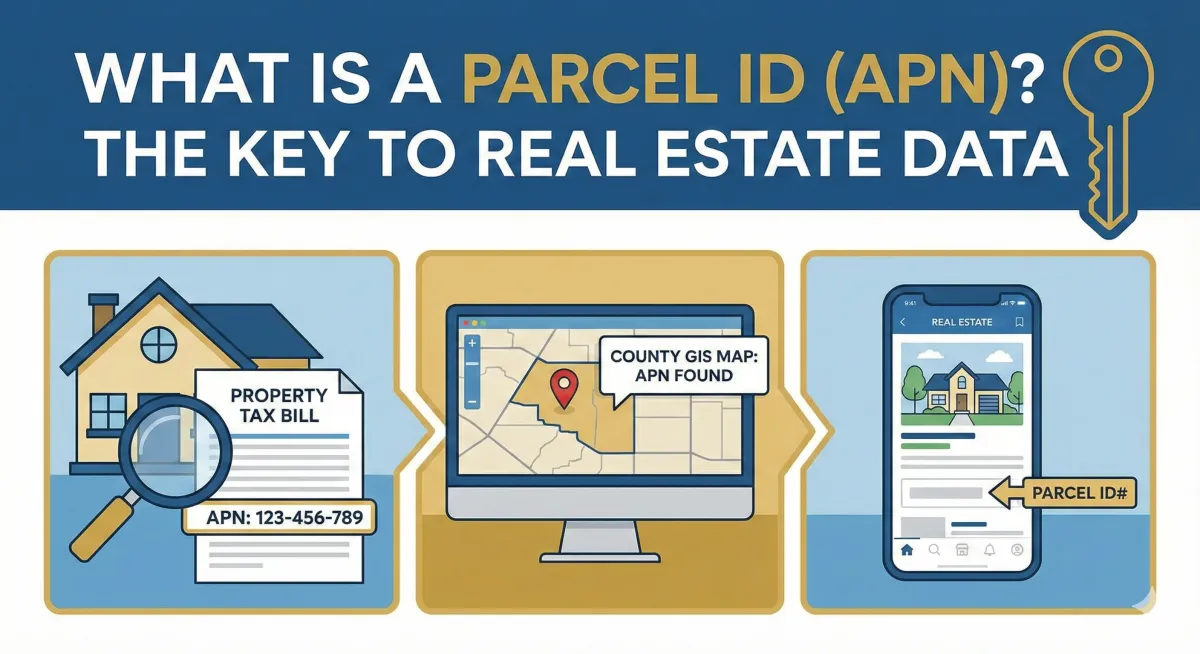
What is a Parcel ID (APN)?
The "Social Security Number" of Real Estate
If you are buying a house, paying property taxes, or trying to figure out exactly where your property lines end, you have likely run into a confusing string of numbers called the Parcel ID or APN.
It looks like a random code, but this number is the most important identifier for any piece of land. It is essentially the "Social Security Number" for real estate.
Whether you are a first-time homebuyer or an experienced investor, understanding how to find and read a Parcel ID is crucial for verifying ownership and avoiding costly property disputes.
The Technical Basics: What is an APN?
APN stands for Assessor's Parcel Number. Depending on where you live, it might also be called:
PID (Parcel ID)
PIN (Property Identification Number)
Folio Number
Tax Map Number
Regardless of the name, the function is the same: it is a unique numeric or alphanumeric code assigned to a specific plot of land by the local county tax assessor. Unlike a street address, which can change (e.g., if a street is renamed or houses are renumbered), the APN stays with the land itself.
The Structure of the Number
While every county uses a slightly different system, most APNs follow a "Book-Page-Parcel" format.
Example:
123-456-789123 (Book): The specific map book in the assessor's office.
456 (Page): The page number within that map book.
789 (Parcel): The specific lot number on that page.
Why Do You Need Your Parcel ID?
You might think your street address is enough, but for legal and financial matters, the APN is king. You will strictly need it for:
Paying Property Taxes: Tax bills are issued by APN, not just by address.
Checking Zoning & Permitting: Want to build a shed or add a pool? The city planning department will look up your regulations via the APN.
Ordering a Survey: Surveyors use the APN to locate the recorded deed and legal description.
Buying Vacant Land: Many plots of raw land don't have street addresses yet. The APN is the only way to identify them.
How to Find a Parcel ID (4 Fast Ways)
If you don't know the APN for a property, don't worry. It is public record, and there are four easy ways to find it for free.
1. Check the Property Tax Bill
This is the easiest method. If you already own the home, grab your latest property tax bill. The APN will be clearly listed at the top, usually near the legal description.

A mock property tax bill showing the Parcel ID Number (APN) highlighted near the top of the statement.
2. Search the County Assessor’s Website
Almost every county in the U.S. has an online property search portal.
Google search: "[Your County Name] Assessor Property Search"
Enter the street address.
The result will display the owner's name, assessed value, and the Parcel ID.
3. Use a GIS Map
County "GIS" (Geographic Information System) maps are powerful, interactive tools that show property lines overlayed on satellite images.
Google search: "[Your County Name] GIS Map"
Zoom into the specific house or lot on the map.
Click on the lot, and a box will pop up with the APN and other data.
4. Check Real Estate Listings (Zillow/Redfin)
Even if you aren't buying, these sites are great for data.
Search for the address on Zillow or Redfin.
Scroll down to the "Facts and Features" or "Public Facts" section.
Look for the field labeled Parcel Number.
Decoding the Mystery: "Parent" vs. "Child" Parcels
This is a common issue for land investors and developers.
Parent Parcel: A large tract of land before it is subdivided.
Child Parcel: When a large tract is split into smaller lots, the county assigns new APNs to the new lots (the "children") and retires or modifies the old APN (the "parent").
Pro Tip: If you are buying a newly subdivided lot, it may take months for the county to issue a new APN. Until then, you may be referenced by the parent parcel number, which can complicate tax calculations.
FAQ: Common Questions About Parcel IDs
Q: Can two houses have the same APN? A: Generally, no. Each legal lot gets a unique number. However, if you have a "condo" or a property with multiple units on one legal lot (like a duplex), they might share a base APN or have a slight variation (e.g., -01, -02) added to the end.
Q: Does the APN change if I sell the house? A: No. The APN is tied to the land, not the owner. It transfers with the property.
Q: I found the APN, but there is no address. Is that normal? A: Yes, specifically for vacant land. Raw land is often identified only by its APN until a structure is built and the postal service assigns a street number.
Conclusion
The Parcel ID / APN is the DNA of your property. While you might memorize your address, knowing your APN is the key to unlocking accurate tax info, permit history, and boundary lines. Before you make your next real estate move, take five minutes to find your number—it’s the smartest "background check" you can do on a piece of land.